Friday, June 10, 2011

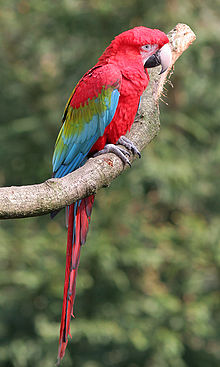
Green Winged Macaw


The Red-and-green Macaw (Ara chloropterus), also known as the Green-winged Macaw, is a large mostly-red macaw of the Ara genus.

This is the largest of the Ara genus, widespread in the forests and woodlands of northern and central South America. However, in common with other macaws, in recent years there has been a marked decline in its numbers due to habitat loss and illegal capture for the parrot trade.

Description
Four flying in PeruThe Red-and-green Macaw can be readily identified from the Scarlet Macaw as whilst the breast of both birds is bright red, the upper-wing covert feathers of the Red-and-green Macaw are green (as opposed to yellow, or yellow and green in the Scarlet Macaw). In addition, the Red-and-green Macaw has characteristic red lines around the eyes formed by rows of tiny feathers on the otherwise bare white skin patch; this is one of the biggest differences from a Scarlet Macaw to the casual viewer. Iridescent teal feathers are surrounded by red on the tail.

It is second only in size to the Hyacinth Macaw, the largest bird of the macaw family. The wingspan of the Red-and-green Macaw can be up to 49 inches (125 cm), with a total body length of 39 inches (100 cm).[citation needed] A healthy adult will weigh between 1,250 and 1,700 grams (2.7-3.7 lbs).[citation needed]

The Red-and-green Macaw has a very powerful beak which can generate a pressure of 2000 psi and can snap a broomstick in half.[2] This powerful beak has evolved to crush or open even the hardest nuts and seeds.

Behavior The Red-and-green Macaw generally mates for life. The female typically lays two or three eggs in a nest made in a hole in a tree. The female incubates the eggs for about 28 days, and the chicks fledge from the nest about 90 days after hatching.[3]

Hyacinth Macaw


Native to central and eastern South America, the Hyacinth Macaw (Anodorhynchus hyacinthinus), or Hyacinthine Macaw, is the largest macaw and the largest flying parrot species in the world, though the flightless Kakapo of New Zealand can outweigh it at up to 3.5 kg. In terms of length it is larger than any other species of parrot. While generally easily recognized, it can be confused with the far rarer and smaller Lear's Macaw. Their popularity as pets has taken a heavy toll on their population in the wild.

Description The Hyacinth Macaw is 100 cm (3.3 ft) long from the tip of its tail to the top of its head and 1.200–1.700 kg (2.65–3.75 lb) in weight.[1][2] Each wing is 388–425 mm (15.3–16.7 in) long.[1] Its feathers are entirely blue, lighter above and darker on its wings.[1] It has a large black curved beak. It has bright-yellow bare skin at the base of its lower beak and also yellow bare skin circling its eyes.[3] Male and female have identical external appearances.[1]

Food and feeding They have a very strong beak for eating their natural foods, which include the kernel of hard nuts and seeds. Their strong beaks are even able to crack coconuts, the large brazil nut pods and macadamia nuts. In addition, they eat fruits and other vegetable matter. Pine nuts are also one of the most popular foods. In the Pantanal, Hyacinth Macaws feed almost exclusively on the nuts of Acrocomia aculeata and Attalea phalerata palm trees.

ReproductionThese birds nest in existing holes in trees. The clutch size is one or two eggs, although usually only one fledgling survives as the second egg hatches several days after the first, and the smaller fledgling cannot compete with the first born for food. Juveniles stay with their parents until they are three months old. They are mature and begin breeding at seven years of age. Eggs are regularly predated by corvids, possums, coatis and (most prolifically) toucans.[4] Adults have no known natural predators.[2]

Distribution and habitat Hyacinth Macaws in their natural habitat, the Pantanal, Brazil.The Hyacinth Macaw survives today in three main populations in South America: In the Pantanal region of Brazil, and adjacent eastern Bolivia and northeastern Paraguay, in the Cerrado region of the eastern interior of Brazil (Maranhão, Piauí, Bahia, Tocantins, Goiás, Mato Grosso and Minas Gerais), and in the relatively open areas associated with the Tocantins River, Xingu River, Tapajós River, and the Marajó island in the eastern Amazon Basin of Brazil. It is possible that smaller, fragmented populations occur in other areas. It prefers palm swamps, woodlands, and other semi-open wooded habitats. It usually avoids dense humid forest, and in regions dominated by such habitats, it is generally restricted to the edge or relatively open sections (e.g. along major rivers).

Conservation
At La Palmyre Zoo, FranceThe Hyacinth Macaw is an endangered species due to overcollection for the cage bird trade and habitat loss. Annual grass fires set by farmers can destroy nest trees, and regions previously inhabited by this macaw are now unsuitable due to cattle-ranching, hydroelectric power schemes, agriculture and plantations. Locally, it has been hunted for food, and the Kayapo Indians of Gorotire in south-central Brazil use its feathers to make headdresses and other baubles. While overall greatly reduced in numbers, it remains locally common in the Brazilian Pantanal, where a specific program, the Hyacinth Macaw Project, among others involving artificial nests and awareness campaigns, has been initiated by several ecolodges, and many ranch-owners now protect the macaws on their land.

Friday, November 5, 2010

Major Mitchell Cockatoo


The Major Mitchell's Cockatoo, Lophochroa leadbeateri, also known as Leadbeater's Cockatoo or Pink Cockatoo, is a medium-sized cockatoo restricted to arid and semi-arid inland areas of Australia. It is here placed in its own monotypic genus Lophochroa, though to include it in Cacatua as others do is not wrong as long as the corellas are also included there

With its soft-textured white and salmon-pink plumage and large, bright red and yellow crest, it is generally recognised as the most beautiful of all cockatoos. It is named in honour of Major Sir Thomas Mitchell, who wrote "Few birds more enliven the monotonous hues of the Australian forest than this beautiful species whose pink-coloured wings and flowing crest might have embellished the air of a more voluptuous region".

It is possibly (though not certainly) a little closer related to Cacatua than the Galah, and its lineage diverged around the time of or shortly after the acquisition of the long crest – probably the former as this crest type is not found in all Cacatua cockatoos and therefore must have been present in an early or incipient stage at the time of the divergence of the Major Mitchell's Cockatoo's ancestors. Like the Galah, this species has not lost the ability to deposit diluted pigments dyes in its body plumage, although it does not produce melanin coloration anymore, resulting in a lighter bird overall compared to the Galah. Indeed, disregarding the crest, Major Mitchell's Cockatoo looks almost like a near-leucistic version of that species (see also "External links" below). Another indication of the early divergence of this species from the "white" cockatoo lineage is the presence of features found otherwise only in corellas, such as the plaintive yodeling cry, as well as others which are unique to Major Mitchell's and the true white cockatoos, for example the large crest and rounded wing shape.[1]

The scientific name commemorates the British naturalist, Benjamin Leadbeater. In Central Australia south of Alice Springs, the Pitjantjatjara term is kakalyalya.[3]

Distribution and habitat
Unlike the Galah, Major Mitchell's Cockatoo has declined rather than increased as a result of man-made changes to the arid interior of Australia. Where Galahs readily occupy cleared and part-cleared land, Major Mitchell's Cockatoo requires extensive woodlands, particularly favouring Callitris, Allocasuarina and Eucalyptus. In contrast to other cockatoos, Major Mitchell pairs will not nest close to one another; in consequence, they cannot tolerate fragmented, partly-cleared habitats, and their range is contracting.

In the Mallee region of Victoria where the Galah and Major Mitchell's Cockatoo can be found to be nesting in the same area, there has been on occasion where the two species have interbred and produced hybridised offspring[4]

Galah Cockatoo


The Galah (pronounced /ɡəˈlɑː/), Eolophus roseicapilla, also known as the Rose-breasted Cockatoo, Galah Cockatoo, Roseate Cockatoo or Pink and Grey, is one of the most common and widespread cockatoos, and it can be found in open country in almost all parts of mainland Australia.

It is endemic in Australia (and introduced to Tasmania [1]), where its distinctive pink and grey plumage and its bold and loud behaviour make it a familiar sight in the bush and increasingly in urban areas. It appears to have benefited from the change in the landscape since European colonisation and may be replacing the Major Mitchell's Cockatoo in parts of its range.Galahs are found in all Australian states, and are absent only from the driest areas and the far north of Cape York Peninsula. It is still uncertain whether they are native to Tasmania, though they are locally common today, especially in urban areas. [4]. They are common in some metropolitan areas, for example Adelaide, Perth and Melbourne, and common to abundant in open habitats which offer at least some scattered trees for shelter. The changes wrought by European settlement, a disaster for many species, have been highly beneficial for the galah because of the clearing of forests in fertile areas and the provision of stock watering points in arid zones.

Flocks of galahs will often congregate and forage on foot for food in open grassy areas.Galahs are highly social and very long-lived; though they are sometimes kept as pets, this is not something to be undertaken lightly as they bond socially with their owners and may well outlive them, and like most cockatoos, are noisy and require a great deal of attention and care. They are however very easy to keep and maintain as pets. Both male and female galahs are great talkers, but the male is thought to be the better talker. They're very loving and affectionate birds that have a tendency to purr like cats as a sign of their affection. They form a very strong bond with their owner and like to think of themselves as 'part of the family'. However, they do like their privacy at times and are quite happy to simply be around the family rather than be handled all hours of the day.


The term galah is derived from gilaa, a word found in Yuwaalaraay and neighbouring Aboriginal languages.[2]
Galahs are about 35 cm (14 in) long and weighs 270–350 g. It has a pale grey to mid-grey back, a pale grey rump, a pink face and chest, and a light pink mobile crest. It has a bone-coloured beak and the bare skin of the eye rings is carunculated. It has grey legs. The genders appear similar, however generally adult birds differ in the colour of the irises; the male has a very dark brown (almost black) irises, and the female has a mid-brown/red irises. The colours of the juveniles are duller than the adults. Juveniles have greyish chests, crowns, and crests, and they have brown irises and whitish bare eye rings, which are not carunculated.[3]

Gang -Gang Cockatoo


The Gang-gang Cockatoo, Callocephalon fimbriatum, is found in the cooler and wetter forests and woodlands of Australia, particularly alpine bushland. Mostly mild grey in colour with some lighter scalloping (more pronounced and buffish in females) the male has a red head and crest, while the female has a small fluffy grey crest. It ranges throughout south-eastern Australia and Tasmania. The Gang-gang Cockatoo is the faunal emblem of the Australian Capital Territory. It is easily identified by its distinctive call, which is described as resembling a creaky gate, or the sound of a cork being pulled from a wine bottle.

The name Gang-gang comes from a New South Wales Aboriginal language, either Breeding
Unlike most other cockatoos, Gang-gangs nest in young, solid trees, the females using their strong beaks to excavate nesting cavities.

[edit] Status
Lots of older, hollow trees and loss of feeding habitat across south-eastern Australia through land clearing has led to a significant reduction in the numbers of this cockatoo in recent years. As a result, the Gang-Gang is now listed as vulnerable.[citation needed]

[edit] Taxonomy
The Gang-gang Cockatoo was most often allied with the white cockatoos of the genus Cacatua. This has always been controversial due to the unusual appearance and coloration of the bird, especially its sexual dichromatism. New research has finally resolved the matter, with the Gang-gang Cockatoo being recognized as a distinctive early offshoot of the calyptorhynchine (dark) cockatoos (Brown & Toft, 1999). Considering the robust phylogeny of the cockatoos now established, a comparison of characters gained and lost during the evolution of cockatoos suggests that the Gang-gang Cockatoo - while of course much changed and adapted during the maybe 20 million years since its last common ancestor with any other living species lived - is probably still very similar in overall appearance to how the earliest cockatoos would have looked, and certainly the most primitive-looking of the species alive today.
Ngunnawal or Wiradjuri. It is possible both language groups called it gang gang.

Greater Sulphur Cockatoo


Greater Sulphur Crested Cockatoo
cacatua galerita

Length: 38-51cm/15-20 inches
Weight: 350-500 grams
Life span: 40-60 years
Incubation: 30 days
Age at weaning: 14 weeks
Age at maturity: 3 years
Natural habitat: Australia, New Zealand, Indonesia, New Guinea and offshore islands.

The Greater Sulphur Crested Cockatoo is a fairly common bird in lowland forests and savannah country. In Australia they are common inhabitants of forests, open wooland and farmland. They are noisy, conspicuous birds. Usually found in pairs or small family parties during the breeding season, at other times they are found in flocks of several hundred.


Whenever they frequent open countryside they have a sentinel warning system. A few birds remain perched at the top of trees while the flock feeds on the ground below. At the approach of danger the sentinels rise into the air screeching loudly. The rest of the flock are warned and they too rise into the air.

They feed on seeds, fruits, berries, nuts, flower, leaf buds, roots as well as insects and their larvae. They are known as pests in crop-growing areas, although they do eat a considerable amount of weed seeds as well.


They nest in a hollow limb or tree trunk, generally high up and frequently near a water source. The normal clutch is 2 eggs.

The adult Greater Sulphur Crested Cockatoo is mostly white. They have a large forward curving crest which is yellow. Like the Lesser Sulphur Crested they have yellow under their wings and tail, this is easily seen when they are in flight. Their beak is black and their eye rings are white.


Pet potential: Hand raised Cockatoos make exceptionally loving pets. They are both friendly and intelligent, and are very social, affectionate creatures. They are natural chewers, Cockatoos must be provided with branches or strips of wood. Some birds can be very noisy, especially during the early morning and evening hours. Sulphur Crested Cockatoos may be less prone to developing behaviour such as feather plucking and screaming then other popular Cockatoo species. However, these birds have a lot more energy then species such as the Umbrella Cockatoo and need to be kept occupied and stimulated.


Talking ability: Poor-Moderate


Noise level: High


Cage requirements: 3 x 4 x 5 foot


Interesting fact: The Greater Sulphur Crested Cockatoo will mob birds of prey and even throw sticks at them.

Another interesting fact: There are five major types of Sulphur Crested Cockatoo. The Lesser, Citron Crested, Eleonora (or Medium Sulphur Crested), Greater Sulphur Crested and Triton. They all have very similar personalities, though the smaller 3 are known for being a bit more highly strung. What separates them from the other Cockatoo species are their tall, narrow crests which are yellow for them all but the Citron Crested, which is orange.

Medium Sulphur


Medium Sulphur Crested Cockatoo
cacatua galarita eleonora

Length: 44cm/17 inches
Weight: 550-600 grams
Life Span: 50+ years
Incubation: 28 days
Age at Weaning: 14 weeks
Age at Maturity: 2 -3 years
Natural Habitat: Aru Islands, Indonesia

Medium Sulphur Crested Cockatoos seem to be happy anywhere where there are trees, from forests and open woodland to partially cleared areas and arid areas with stands of trees. They can normally be seen in pairs or small flocks and, occasionally, in larger flocks near fruiting trees. They tend to roost in tall trees on the forest edge and at dawn they can be heard screeching loudly as they fly off to the nearest water.


Their diet consists of seeds, fruit, berries, nuts, buds, flowers as well as insects and their larvae. They also regularly visit cultivated areas where they cause considerable damage to farmers crops.

They nest in hollows in tall trees, normally near water. A normal clutch is 2, occasionally 3, eggs. The young will start to leave the nest at around 10 weeks, their parents will continue to feed the young until they are fully weaned at around 12-13 weeks.

The Medium Sulphur Crested Cockatoo is predominantly white. Their ear coverts are pale yellow, and their crest is also yellow. Their under wing coverts and under tail coverts are white washed with yellow, and the base of their throat and their cheek feathers are yellowish The skin to their periophthalmic ring is whitish, occasionally with a very faint blue tinge. Their legs and feet are a dark grey and their bill is blackish. The only difference with the sexes is the iris's of the male are blackish brown and the iris's of the female are reddish brown, though all immature birds have brown iris's.

Pet potential: Medium Sulphur Crested Cockatoos are highly intelligent birds and they require much attention from their owners. They are also very destructive and need to be given lots of fresh branches to chew, and toys to play with, to keep them occupied. As with all Cockatoo's they need a routine from day one, without this routine they will quickly resort to screaming for attention. They are not really known for their talking ability but they will learn a few words however, they can easily be taught tricks and they love interactive toys, these will keep them occupied for ages. They are not a beginners bird and if they are not given the right conditions they will start plucking. It's worth noting that the most rescued birds are Cockatoo's by a very large margin. They are extremely noisy and are unsuitable for anyone with close neighbours. As with all of the large Cockatoos a lot of research should be done before committing yourself to one of these beautiful birds.


Talking ability: Poor


Noise level: Extremely High


Cage requirements: Minimum 3 x 4 x 5 foot

Interesting fact: The Medium Sulphur Crested Cockatoo, or the Eleonora Cockatoo, is in fact a subspecies of the the Greater Crested Cockatoo (cacatua galerita) although sometimes the larger Lesser Sulphur Crested Cockatoos are mistaken for them.